
Tips
How do I protect my bike against theft in the Netherlands?
TL;DR: Protect your bike with two different ART-approved locks, lock the frame to a fixed object, park where people can see it and register your bike for free at BIKEBAZE. On an e-bike, take the battery and display with you. A SafeTag, a tracker and insurance add extra protection.
··Last updated:
Bike theft remains a big problem in the Netherlands. In 2025 the police registered 86,950 bike thefts, compared with 66,675 in 2019, a rise of around 30% (CBS StatLine, provisional figure; CBS is Statistics Netherlands). The real number is higher, because not everyone files a police report. According to CBS research, an estimated 928,000 bikes were stolen in 2023. The total damage from bike theft that year was around €698 million (CBS).
Fortunately there are many practical measures you can take today. Below you will read which protection really makes a difference and how to combine it smartly, including the Dutch terms and organisations you will come across.
The six most important rules in short
At BIKEBAZE we analyse thousands of theft reports every year. The same six rules come out of that data again and again:
- Double lock. Use two separate locks. A chain that is only attached to your ring lock does not count as a second lock.
- Fixed object. Always secure your bike to a fixed object with the frame, and include the front wheel when possible.
- Remove the battery. Do you ride an e-bike? Take the battery out as soon as you park.
- Park in view. Choose a spot with social control whenever possible.
- On short stops too. Apply these rules even when you just pop into a shop.
- Always. Also in places that feel safe, such as guarded bike parking, shared storage rooms and your own shed.
Below you will read, point by point, how to do it well and what else helps.
1. Use two good bike locks and attach them the right way
A good lock is the basis of bike security. Preferably use two different types of lock, for example a ring lock (the frame-mounted wheel lock that almost every Dutch bike has) and a sturdy chain lock or U-lock. A plug-in chain that only hangs from your ring lock does not count as a second lock. This way a thief needs more time and often different kinds of tools. Also make sure your bike is attached to something that cannot be carried away.
Which ART lock do you need?
ART is the Dutch certification for bike locks. The ART mark shows that a lock has been tested on, among other things, resistance to theft attempts and durability. Stichting ART, the independent foundation behind the mark, distinguishes five levels:
- ART 1: basic protection, for example as an additional lock to stop someone walking off with your bike.
- ART 2: suitable for bicycles and the required minimum level for many bike insurance policies.
- ART 3: heavier protection, intended for mopeds and scooters and also worth considering for expensive e-bikes with a high theft risk.
- ART 4 and ART 5: heavy locks, mainly for motorcycles.
Well-known makers of ART-approved locks include AXA and ABUS. Always check the exact lock model and the ART approval number, because not every lock of the same brand has the same certification level. You can do that at Stichting ART, which has an English version of its site. Want to know more about the certification and how to use it? Read everything you need to know about ART locks for your bike.
Mind your insurance: for an ordinary bike one ART 2 lock is often the basis, but insurers can set other requirements. At the ANWB, the Dutch motoring and cycling association that is also a major bike insurer, new e-bike policies have had a second-lock requirement since 1 March 2024: both locks must be at least ART 2. A plug-in chain does not count there as an independent second lock. So always check your own policy.
How do you lock your bike properly?
An expensive lock helps little if you use it wrongly. Follow these practical tips:
- Lock the frame to something immovable. Use a sturdy bike rack, a suitable post or another anchored object. Do not lock only a wheel: it can be removed.
- Use the ring lock for the rear wheel and use the second lock to attach the frame to the fixed object. Include the front wheel too if you can, so that frame, front wheel and fixed object are in one lock. Otherwise a loose front wheel is removed in no time.
- Keep a chain lock off the ground. A chain lying on the ground gives thieves more ways to use tools as a lever.
- Fit a U-lock as compactly as possible. Choose a spot close to the frame, with little free space inside the shackle and without the lock sitting in a position that is convenient for an attack with tools.
- Check the object you lock to. A loose post, a thin fence or a rack you can lift the lock over offers little protection.
Common mistake: you use two excellent locks, but only lock the bike to itself. A thief can then still lift it up and take it away.
2. Park your bike smartly, also at home
Where you leave your bike matters a lot. Preferably choose a busy, well-lit spot with enough social control, but make sure your bike is properly locked there too.
- Guarded bike parking (bewaakte fietsenstalling): at many train stations and shopping centres you will find guarded bike parking facilities. Some are free for the first 24 hours. Check the local conditions and opening hours.
- On the street: avoid deserted alleys, dark corners and places where a bike can stand unnoticed for a long time. Lock your bike even for a quick errand.
- At the station: use the official bike parking and watch the maximum parking time. Otherwise the municipality (gemeente) may remove your bike and take it to the municipal bike depot.
- At home: preferably put your bike in a locked shed, garage or bike storage room. Use a good lock there too, if possible attached to a sturdy wall or ground anchor.
A bike that is kept indoors is not automatically safe. Bikes are also stolen from sheds, the shared storage rooms (berging) of apartment buildings and garages. Insurers can also set requirements for how your bike was locked indoors.
Extra tip: make locking up properly a habit
Do the same short check every time you park: ring lock closed, second lock through the frame, fixed object checked, loose accessories taken with you. That way you are less likely to forget an important step.
3. Register your bike and record your ownership
A good lock helps prevent theft. Bike registration helps with recognition, ownership transfer and recovery if your bike does get stolen. That is why it is smart to register your bike before anything happens.
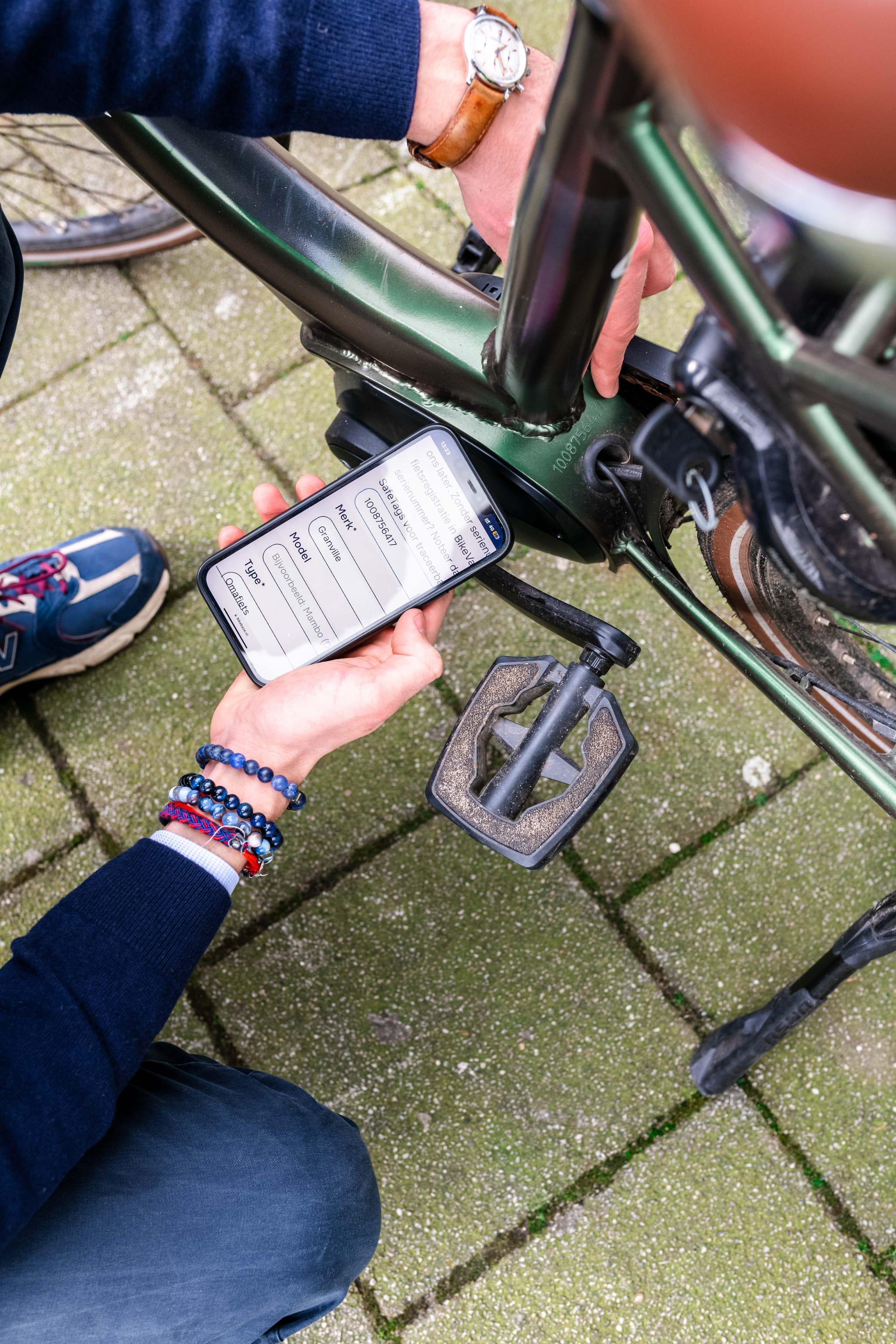
At BIKEBAZE, the only accessible bike registry in the Netherlands, you register your bike in your name for free. You link your bike to the frame number and can later easily transfer the registration when you sell the bike. That way you have your bike details and a digital proof of ownership neatly in one place.
Which details should you keep?
Create a small digital file of your bike straight after purchase:
- Frame number: write it down exactly as it appears on the frame. You usually find it under the bottom bracket, on the down tube or on the seat tube. Also read what a bike frame number looks like and where to find it.
- Photos: take photos of the complete bike, the frame number, brand, model, colour and distinctive features such as a striking saddle, stickers or accessories.
- Proof of purchase and warranty details: keep your invoice or receipt digitally.
- Lock details: keep the ART approval number, the receipt of the lock, the key number and both original keys.
- Extra identification: record any chip numbers, battery numbers and the details of a tracker.
These details are useful for an insurance claim, a police report and recognising your bike on a second-hand platform.
What does BIKEBAZE add?
With BIKEBAZE you combine several advantages:
- Free registration: your bike and its features are registered in your name in the bike registry.
- Visible prevention: the optional SafeTag, a highly visible, tamper-resistant anti-theft sticker, shows that your bike is registered and traceable.
- Scannable recognition: a finder or buyer can scan the unique SafeTag ID or check the frame number via BIKEBAZE.
- Anonymous contact: a finder can reach the owner through BIKEBAZE without any private details being made public.
- Community: cyclists and partners help spot stolen bikes.
- International reach: your registration can also be looked up outside the Netherlands, which matters when bikes disappear across the border.
- Easy ownership transfer: when you sell your bike, you can transfer the registration digitally.
From our production data from 2022 to 2026, bikes with a SafeTag are stolen 98% less often. A SafeTag does not replace a solid lock, but adds a visible layer of prevention.
Register your bike for free at BIKEBAZE.
4. Give your e-bike, battery and display extra protection
E-bikes are attractive to thieves because of their value and parts. Batteries and removable displays in particular deserve extra attention.
Take removable parts with you
Remove the battery and the display when you leave the bike unattended for a longer time, if your model allows it. An e-bike without a battery or display is less attractive. Some insurers also require you to take an easily removable display with you.
Use suitable locks
Preferably choose two ART-approved locks. For a valuable e-bike, a heavier ART 3 lock can be a good addition. Note: ART 3 is not compulsory for every e-bike. The exact requirements depend on your insurer and policy. At the ANWB, for example, the relevant e-bike policies require two separate ART 2 locks.
Register the battery separately
A battery usually has its own serial number. Write that number down, take a photo and add the battery to your bike registration. With a second SafeTag on the battery you make this valuable part recognisable too.
Want to know more? Read why e-bike batteries get stolen and what you can do about it.
5. Make your bike less attractive to thieves
Thieves often look for bikes that are quick to take and easy to sell on. You can reduce that attractiveness in several ways:
- Take loose accessories with you: think of panniers, lights, bike computers, GPS holders and removable displays.
- Do not stand out unnecessarily: do not leave expensive accessories in view. A simple saddle cover can make your bike less conspicuous and keeps the saddle dry, but it does not replace a lock.
- Show that your bike is registered: a visible SafeTag makes clear that a bike is linked to a registration.
- Do not leave a bike in the same risky spot for days: change parking spots if needed and choose a secured location.
- Check your locks regularly: a damaged lock or a poorly working mechanism offers less protection.
A combination of visible security, good locks and smart parking choices makes theft harder and reduces the chance that a thief picks your bike of all bikes.
6. Consider bike insurance, a tracker or smart security
Besides physical security you can use technology and bike insurance. Each has its own role: locks and SafeTags help with prevention, trackers with locating and insurance with financial damage.
Bike insurance: what should you look out for?
Bike insurance can limit the financial consequences of theft. Before taking out a policy, check whether your existing home contents insurance (inboedelverzekering) perhaps already covers theft from a locked shed or storage room. For theft on the street you usually need separate bike insurance or suitable cover.
When comparing, look at:
- The required ART level and number of locks.
- Any extra requirements for expensive bikes and e-bikes, such as a certified tracker.
- Whether you must hand over both original keys in case of theft.
- The required documents, such as proof of purchase, frame number and police report.
- The reporting deadline, any excess and the payout after a few years.
- The cover for separate parts, such as your battery and display.
Real-world example: at the ANWB, certain e-bikes from €4,500 are subject to a track-and-trace condition on top of the lock requirements. So do not just check whether you are insured, but also whether you meet the security requirements.
GPS tracker or Bluetooth tracker: what is the difference?
A tracker helps you locate your bike once it has disappeared. There are two main types:
- GPS trackers with a mobile connection: depending on the system, they can pass on current location data. You often pay for the hardware plus a subscription or licence.
- Bluetooth network trackers, such as an Apple AirTag or a bike bell with Apple's Find My network: they use compatible devices nearby to pass on a location. They do not work the same way as a GPS tracker with its own mobile connection.
With both types you have to take battery life, range and the surroundings into account. In a closed warehouse, a van or a remote area, locating is sometimes harder. A tracker does not prevent theft and is no reason to lock your bike less carefully. Do you see a location after a theft? Do not confront a suspect yourself, but pass the information on to the police via 0900-8844, the general police number for non-emergencies.
New technology for e-bikes in 2026
More and more solutions complement bike security:
Bosch smart system: with the free eBike Flow app you can, on compatible e-bikes, use eBike Lock, lock the motor support digitally, store important bike details in an eBike Pass and mark your e-bike or battery as stolen. With Flow+ extra digital battery protection becomes available. For a motion alarm, notifications when the bike is moved and live GPS location you also need a compatible ConnectModule. Bosch itself stresses that digital theft protection does not replace a good mechanical lock. See the options at Bosch eBike Systems.
Univé and Bypoint: with a suitable bike insurance policy from Univé, a Dutch insurer, a KIWA-certified track-and-trace system with a valid licence can get you up to 50% discount on the Theft and Damage covers. The Bypoint Tag Smart costs €275 instead of €335 for Univé members (as of November 2026). The discount depends on the promotion and policy conditions and no longer applies once the required licence lapses. See the Univé promotion with Bypoint.
Smart locks and bike alarms: there are app-controlled ring locks, chain locks with smart operation and separate motion alarms. They can give a useful extra warning, but always choose good physical locks that meet your insurer's requirements first.
Make your bike safer in five minutes
Want to start right away? Run through these points:
- Check whether your current lock has a valid ART mark and add a good second lock.
- Make sure you always lock the frame to a sturdy object.
- Choose a safe place to park, at home too.
- Look up your frame number, take photos and keep your receipt.
- Register your bike for free at BIKEBAZE and consider a SafeTag.
- Do you have an e-bike? Also note the battery number and remove loose parts when you park.
- Check your insurance conditions and see whether a tracker is useful for your bike.
Prefer the short version? Read the 6 most important tips to prevent bike theft.
Frequently asked questions about bike security
Which ART lock do I need for my bike?
For ordinary bikes ART 2 is usual and the minimum requirement for many bike insurance policies. An ART 3 lock can offer extra protection for an expensive e-bike or a bike with a higher theft risk. Always check your insurer's requirements.
Should I hang my chain lock high or low?
Preferably keep a chain lock off the ground and attach it to a sturdy object. With a U-lock the main thing is to leave little room for tools and to make sure the lock does not sit in a position that is convenient for a leverage attack.
Why are two different bike locks better?
Two different types of lock usually cost a thief more time and effort. A ring lock combined with a chain lock or U-lock makes your bike harder to take, especially when you lock the frame to a fixed object.
Is a GPS tracker worth it?
It certainly can be, especially for a more expensive bike or e-bike. A GPS tracker can pass on location data, but often requires a subscription. A Bluetooth network tracker such as an AirTag works differently and depends on devices nearby. Neither replaces a good lock.
Is my bike safe if it is in the shed?
Not automatically. Use a good lock in the shed too and attach your bike to a wall or ground anchor where possible. Also check which conditions your insurance sets for theft from a shed or storage room.
Is bike registration free?
Yes. At BIKEBAZE you register your bike for free. You can optionally add a SafeTag for €9.99 to make the registration visible and scannable.
What do I do if my bike is stolen anyway?
First check whether the municipality has taken your bike to the bike depot (fietsdepot). Has your bike been stolen? Then file a police report via politie.nl, online with DigiD (the Dutch digital ID) or at a police station. Report your bike as stolen at BIKEBAZE. You can do this without an account and without a previous registration. From that moment, anyone who looks up the frame number or scans the SafeTag sees that your bike is stolen. A finder can reach you and share the location, all anonymously. Go to report your bike as stolen and read the complete step-by-step guide after bike theft in the Netherlands.
Conclusion: the best bike security has several layers
There is no single lock, sticker or app that prevents every bike theft. The best approach is a combination of two good locks, smart parking, free bike registration and additional security that fits your bike. For an e-bike, add the battery, the display and possibly smart technology.
With BIKEBAZE you make your bike recognisable, record your ownership digitally and join a community that fights bike theft. Add a SafeTag for visible prevention and extra recognisability if your bike does get stolen.
Register your bike for free at BIKEBAZE and make life a lot harder for bike thieves today.
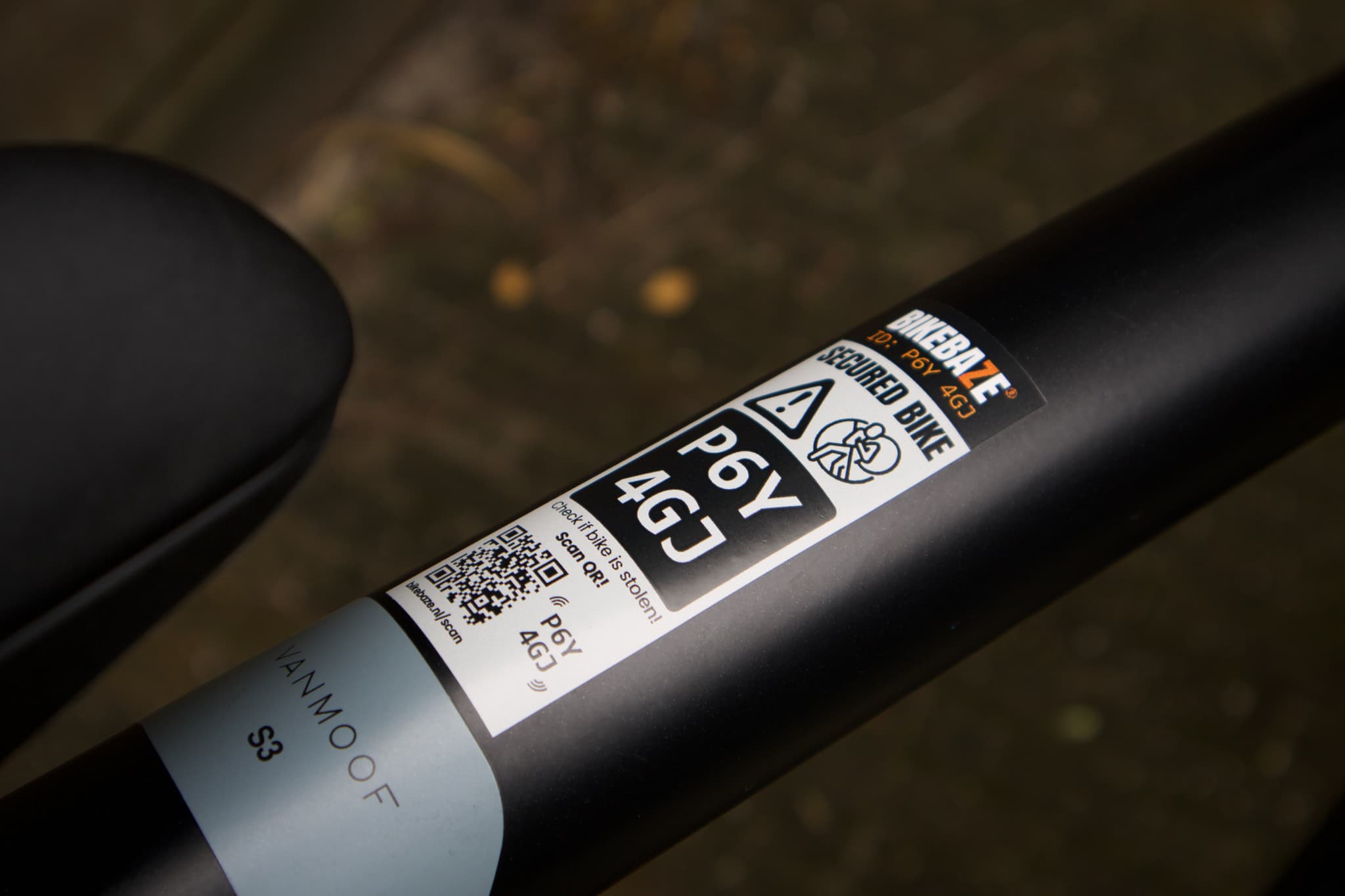
Protect your bike with a SafeTag
The anti-theft sticker that deters thieves and raises the odds of getting your bike back thanks to an active community. Free shipping, ordered before 15:00 ships the same working day.
Tamper-resistant: damage-free removal takes at least 45 minutes
View SafeTagWant to insure your bike too? Get 15% off with Qover
Protect your bike today.
Join thousands of cyclists who register their bike with BIKEBAZE® and help build a safer cycling world.
Register for FREE